

Editorial Content & SEO Specialist
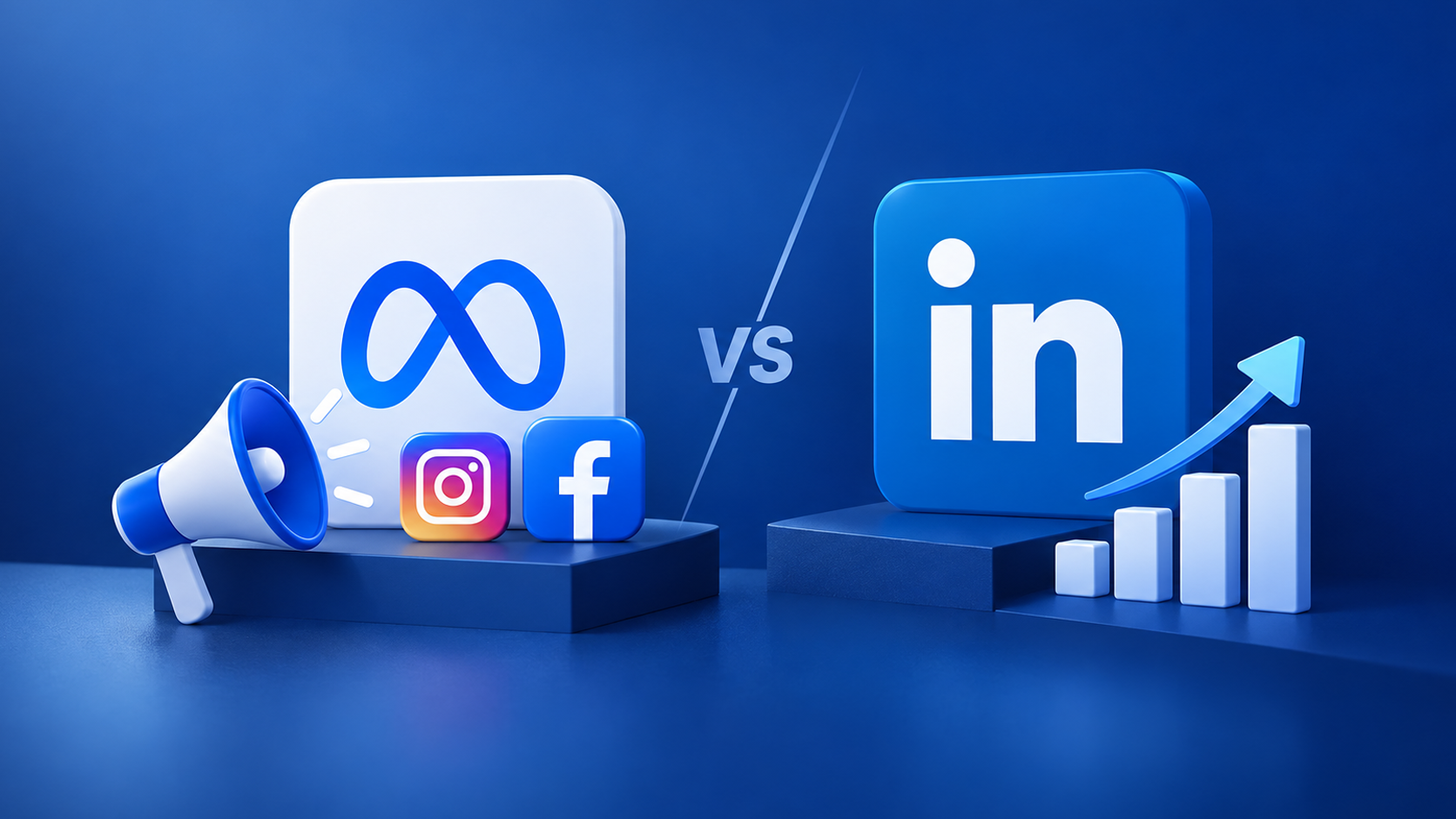
Businesses investing in social media advertising often face the same question: should you spend your budget on Meta Ads or LinkedIn Ads? Both platforms can generate leads, increase brand visibility, retarget potential customers, and drive website traffic, but they are designed around very different audiences and buying behaviors.
Meta Ads primarily reach users across Facebook and Instagram, giving businesses access to large consumer audiences and a wide range of visual advertising formats. LinkedIn Ads, on the other hand, are built around professional data and allow businesses to target people based on factors such as job title, company, industry, seniority, and company size. For businesses considering social media advertising, the better platform usually depends on who you need to reach, what you sell, the value of a new customer, and how people typically make a purchasing decision.
The biggest difference between Meta Ads and LinkedIn Ads is how businesses identify and reach their target audiences.
Meta is generally better suited for reaching consumers based on factors such as location, demographics, interests, previous interactions, customer data, and signals Meta’s advertising system uses to determine who is most likely to respond to a campaign. Ads can appear across Facebook, Instagram, Reels, Messenger, and other eligible Meta placements. Meta also encourages advertisers to test multiple placements and creative formats rather than relying on a single type of ad.
LinkedIn focuses much more heavily on a person’s professional identity. According to LinkedIn’s advertising targeting documentation, advertisers can target audiences using professional attributes including job title, company name, industry, seniority, skills, and other business-related characteristics.
That difference can quickly determine which platform makes more sense. A roofing contractor trying to reach homeowners within 25 miles of Fort Lauderdale may not care what someone’s job title is. A consulting company trying to reach HR directors at organizations with more than 500 employees probably does.
Meta Ads can be a strong option for businesses selling products or services directly to consumers. Local service companies, contractors, pool companies, dental practices, fitness businesses, real estate companies, ecommerce brands, and many other B2C businesses can use Facebook and Instagram to get their services in front of potential customers.
One of Meta’s biggest advantages is that someone does not necessarily need to be actively searching for your service when they see your ad. A homeowner scrolling through Instagram may not have opened the app intending to search for a pool renovation company, but a strong before-and-after video could introduce the idea and create interest.
This is why creative plays such an important role in Meta advertising. Meta’s own guidance for Facebook and Instagram Reels Ads emphasizes vertical video, strong creative, placement testing, and ongoing experimentation. Images, videos, headlines, offers, landing pages, and calls to action all influence whether someone stops scrolling and takes the next step.
Meta can also work well for businesses that have already built website traffic through SEO, Google Ads, organic social media, or other marketing channels. Instead of allowing previous visitors to disappear after one website session, paid social campaigns can help businesses stay in front of audiences that have already shown interest.
LinkedIn Ads tend to become more attractive when a company’s ideal customer can be clearly defined by professional characteristics. This is one reason the platform is commonly associated with B2B lead generation.
A company might need to reach CEOs, marketing directors, HR leaders, architects, engineers, healthcare executives, IT decision-makers, operations leaders, business owners, or employees within a particular industry. LinkedIn allows advertisers to build audiences around these characteristics instead of relying primarily on broader consumer signals.
LinkedIn states that its campaign targeting includes more than 20 audience attributes, including company size, company name, skills, job title, job seniority, interests, and other professional data. You can see the full range in LinkedIn’s guide to advertising on LinkedIn.
This can be especially useful for software companies, consulting firms, manufacturers, professional training organizations, commercial service providers, recruiting companies, and other businesses where reaching the correct decision-maker is more important than reaching the largest possible audience.
For example, a company selling enterprise software to chief technology officers may not need thousands of inexpensive clicks. It may need a relatively small number of qualified visitors who work at the right companies and have influence over purchasing decisions.
Both platforms can generate leads, but the meaning of a “good lead” can be very different from one business to another.
A local home service company may want a consistent volume of homeowners requesting quotes. A B2B consulting company may only need a handful of qualified conversations each month if one new client represents significant revenue.
This is why lead volume should never be evaluated by itself. A campaign generating 100 inexpensive leads is not automatically better than one generating 20 more expensive leads. Lead quality, close rate, customer value, acquisition cost, and eventual revenue provide much more useful context.
Both platforms also provide native lead-generation tools that can reduce the number of steps required for someone to submit their information. LinkedIn offers Lead Gen Forms that can automatically populate information from a member’s profile, while Meta offers lead-focused campaign formats designed to capture inquiries within its platforms.
However, sending prospects directly to a website can still make sense, particularly when the service requires more explanation or the visitor needs to review examples, pricing, qualifications, or other information before contacting the business. In those cases, a dedicated landing page can keep the message aligned with the advertisement and provide a clearer path toward submitting a form, scheduling a consultation, or requesting a quote.
Neither platform has universally “better” targeting. They specialize in different types of audience data.
LinkedIn is particularly valuable when professional information defines the ideal customer. Its targeting tools allow advertisers to use attributes such as job title, seniority, company, company size, industry, and skills. LinkedIn also provides Matched Audiences features for company targeting, contact targeting, website retargeting, and other audience strategies.
Meta is generally stronger when businesses need to reach broader consumer audiences and give the platform room to identify people who are more likely to complete a desired action. Meta also supports Custom Audiences using qualifying customer information and other first-party audience data. Meta’s Custom Audience terms explain how customer data can be used to create these audiences and the requirements businesses must follow when doing so.
Think about the audience you are trying to identify. If the question is, “How can we reach marketing directors at technology companies?” LinkedIn provides professional targeting that directly addresses that need. If the question is, “How can we reach homeowners in South Florida who may be interested in replacing their pool?” Meta may provide a better environment for that campaign.

There is no fixed advertising cost for either platform. Costs change according to factors including competition, target audience, geographic area, campaign objective, creative quality, bidding strategy, and how advertisers compete for available ad placements.
LinkedIn campaigns can often produce higher click and lead costs because advertisers may be targeting narrower professional audiences. That does not necessarily mean LinkedIn is less profitable. A lead can cost considerably more while still making financial sense if the potential customer value is significantly higher.
Imagine a local consumer campaign generates leads for $40 each and the average new customer is worth $800. A separate B2B campaign may generate leads for $150 each, but one new customer could be worth $20,000 or more. Looking only at cost per lead would ignore the economics behind each campaign.
The same principle applies when comparing social media advertising with Google Ads. The cheapest click is not necessarily the most valuable click. Businesses should look at what happens after the click, including qualified leads, appointments, opportunities, sales, acquisition cost, and revenue.
Facebook and Instagram are highly visual environments. Your advertisement is competing with videos, photos, Reels, posts from friends, creators, brands, news, and many other pieces of content.
Strong audience targeting cannot completely compensate for weak creative. A campaign may need multiple images, videos, headlines, hooks, offers, and calls to action so advertisers can identify which combinations generate stronger responses.
Creative should also evolve as campaigns run. An advertisement that initially performs well can lose effectiveness when the same audience repeatedly sees it. Testing new concepts and messaging gives the campaign additional opportunities to find what resonates with potential customers.
This is one of the reasons simply boosting a social media post is different from building a complete paid social strategy. A structured campaign considers audience targeting, creative testing, conversion tracking, landing pages, retargeting, budget allocation, and the actions users take after clicking.
LinkedIn users are interacting with the platform in a more professional context, so effective advertising typically needs to communicate business value quickly.
Instead of focusing only on general brand messaging, an ad may address a particular business problem such as improving productivity, generating revenue, reducing costs, strengthening employee engagement, simplifying a workflow, improving compliance, or solving an operational challenge.
The offer matters as well. Depending on the business and buying stage, LinkedIn campaigns may promote consultations, demonstrations, webinars, reports, case studies, guides, events, or direct service inquiries.
Because many B2B purchasing decisions involve longer sales cycles, an advertisement does not always need to produce an immediate sale. It may begin a relationship that continues through additional content, retargeting, email follow-up, sales conversations, and future advertising.
Many website visitors are not ready to contact a business during their first session. They may review a service page, compare companies, read an article, look at pricing, and leave.
Retargeting gives businesses another opportunity to stay visible to people who have already interacted with their brand. LinkedIn’s Matched Audiences features include retargeting based on actions people have taken with a business, while Meta provides audience tools that can be incorporated into retargeting strategies.
This is where your website becomes an important part of paid advertising. At Ninety Web Design, we look at paid campaigns as part of a larger lead-generation system. The advertisement may bring the visitor in, but the website still needs clear messaging, a strong offer, fast performance, effective calls to action, and an easy way to convert.
A strong ad sending visitors to a confusing page can waste advertising dollars regardless of how well the audience was targeted.
Businesses do not always have to choose one platform.
A B2B company could use LinkedIn to reach a specific group of decision-makers and use Meta campaigns as another touchpoint for broader awareness or retargeting. A business with both consumer and commercial divisions may use Meta for its B2C audience while running LinkedIn campaigns for corporate prospects.
The important thing is not to copy the exact same campaign across both platforms and expect identical performance. People use Facebook, Instagram, and LinkedIn differently. The creative, messaging, offers, audience strategy, and conversion path should reflect those differences.
Campaign budgets should also be evaluated based on performance rather than divided equally simply because two platforms are being used. Over time, conversion data can help determine where additional advertising dollars have the greatest potential.
Meta Ads often make sense for businesses that primarily sell to consumers, homeowners, or broad local audiences. That can include home service companies, pool contractors, dentists, fitness businesses, ecommerce brands, real estate companies, restaurants, consumer professional services, and other local businesses.
Companies with highly visual products or services may have an additional advantage because Facebook and Instagram provide opportunities to demonstrate results through imagery and video. Before-and-after projects, customer experiences, products, transformations, and demonstrations can all become advertising creative.
LinkedIn may be a better fit when reaching a specific professional or company is central to the sales strategy. Examples include B2B software providers, consulting companies, commercial service providers, corporate training firms, manufacturers, professional organizations, recruiters, and companies pursuing account-based marketing strategies.
LinkedIn can also be valuable when only a relatively small percentage of the population represents a realistic potential customer. If a service is designed specifically for CFOs at companies with more than 1,000 employees, broad consumer reach may be far less useful than precise professional targeting.
The platform should follow the customer, not the other way around. Before launching a campaign, define who you need to reach, how that person can be identified, how valuable a qualified lead is, how long the buying process takes, what message is likely to capture their attention, and what action you want them to take after seeing the advertisement.
Meta may offer a better environment for consumer-focused and local lead-generation campaigns, while LinkedIn provides professional targeting that can be particularly useful for B2B advertisers. Some businesses may benefit from using both.
What matters most is connecting the platform to a complete campaign strategy. Strong paid social advertising combines audience targeting, creative, messaging, landing pages, retargeting, conversion tracking, and ongoing optimization rather than evaluating success based only on impressions or clicks.
At Ninety Web Design, our social media advertising services include Meta and LinkedIn campaign management focused on reaching better-fit audiences and turning paid traffic into measurable opportunities. We connect the ads with the landing experience, tracking, creative, and conversion strategy so businesses can better understand what their advertising budget is actually producing.
How Much Do Google Ads Cost in Fort Lauderdale?

How Much Does SEO Cost In Fort Lauderdale?

How Custom Web Design Impacts SEO and Search Visibility

Benefits of WP Engine WordPress Hosting
Sign up for our newsletter
You may unsubscribe from these communications at any time. For more information, check out our Privacy Policy.